
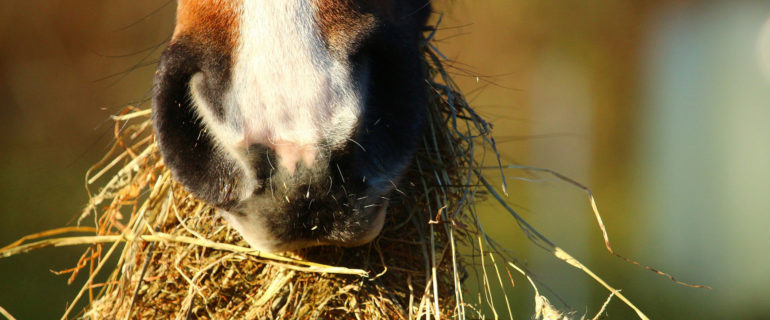
Concerned about your horse’s respiratory health? HorseHage is the nearest thing you can get to grass in the field, and is specifically designed to support his airways.
With so much wet weather and fields already looking very sparse, your horse will need good quality forage to satisfy his innate need to chew, preventing unwanted behaviour and keeping him on top form. The quality of the forage you feed is important for a healthy horse, which can vary hugely in hay and haylage and can result in a lot of waste and/or compromise their respiratory health.
Using HorseHage is a great way to prevent this, as the quality is consistent and reliable and contains nothing else other than the variety stated. It is more digestible than conventional forage which allows more efficient utilisation of the available nutrients, and in turn helps to improve condition and add a natural bloom to the coat. This also means that you can reduce your horse’s hard feed by up to a third!
Why choose HorseHage?
- It is dust free for a healthy respiratory system
- Never requires soaking
- Contains no chemicals, additives, mould inhibitors, flavourings or molasses
- Lower in sugar than other forage
- Consistent in quality
- It is heat sealed into a double skinned bag to prevent puncturing
- It is never re-bagged
- Small bales are easy to handle
- It is FEMAS & BETA NOPS certified
- Two varieties are safe for laminitics
HorseHage was also awarded a Royal Warrant in 1983 as the Queen’s horse benefitted greatly from the dust free forage. They are the official supplier to the British Equestrian Team, and supply the Horse of the Year Show and the British Showjumping National Championships.
HorseHage vs Haylage
It is a common misconception that HorseHage and haylage are the same, but there are several differences:-
- HorseHage is made from specifically cultivated fields that are maintained for consistent nutrient and quality levels. Haylage can be cut from any pasture.
- HorseHage undergoes strict quality control throughout production for consistent moisture content. This can vary hugely in big baled haylage.
- HorseHage is wilted on the field and baled like hay then highly compressed to leave a minimum amount of air in the bag. This ensures optimum fermentation and minimises the growth of bacteria, fungi and moulds. Haylage often contains more air and has less efficient fermentation.
- Haylage is usually wrapped in non-permeable plastic which is easily punctured and subjects it to mould, whereas HorseHage is double wrapped in semi-permeable plastic that allows gas to escape and prevents air from entering.
- The grasses used in HorseHage are only ever harvested at optimum growth and are continually nutritionally analysed to provide accurate information, whereas haylage tends to be cut when the weather is good.
- HorseHage comes in 4 varieties to meet your horse’s requirements – haylage generally only comes in one.
Varieties
The original variety made form ryegrasses cut at an early stage of growth to provide optimum protein and energy levels. Ideal for horses in work, and those that need a little more from their forage, it can also help with weight gain and improving condition.
Made from a selected mix of grasses that are high in fibre but lower in protein and energy levels. It is ideal for leisure horses and ponies as well as those that are resting, convalescing or prone to laminitis. It also provides an excellent fibre source for competition horses being fed high levels of concentrates.
Made from timothy grass which is naturally higher in fibre and lower in energy than many other grasses. It is suitable for leisure horses and those that are resting, convalescing or prone to laminitis. Because it has a different ‘nose’ to ryegrass, it is very appealing and so great for fussy feeders or those that require a little variety.
Made from pure alfalfa (a legume) it has higher levels of protein, digestible fibre, energy, calcium and vitamins than grass. The protein content has the optimum balance of amino acids and lysine – important for growth, pregnancy and milk production, making it ideal for mares and youngstock, as well as horses in hard work or poor doers.